Google Drive is Not DPDP Compliant
Why your organization's default document storage is a ₹250 crore liability in waiting.

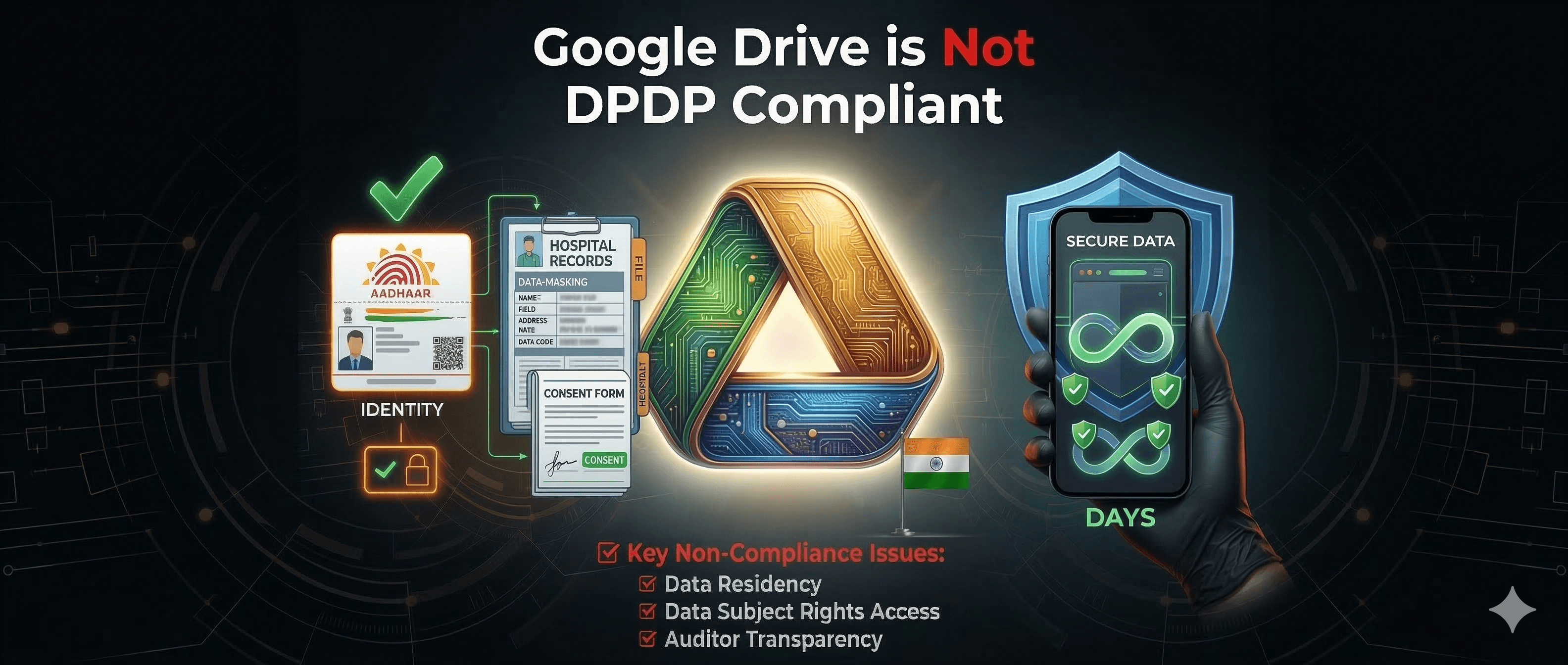
If you work at an Indian organisation of any size, there is a very high chance your team is using Google Drive to store sensitive documents. Patient records. Employee Aadhaar copies. Vendor contracts. Student admission files. Beneficiary data.
It feels safe because it is Google. It feels organised because folders exist. It feels secure because there is a password on the account.
It is none of those things from a DPDP Act compliance standpoint.
Why Google Drive Creates DPDP Liability
The Digital Personal Data Protection Act 2023 places clear obligations on every Indian organisation that collects and stores personal data. Google Drive fails on several of the most fundamental ones.
Data localisation. The Act and its associated rules require that certain categories of sensitive personal data be stored on servers within India. Google Drive stores data on Google's global infrastructure. By default your documents are not guaranteed to be on Indian servers. For hospitals, government organisations, and any entity dealing with sensitive personal data this is a direct compliance gap.
No consent records. When someone shares a document via Google Drive there is no consent record attached. No record of why the data was collected, with whose permission, for what purpose, and how long it will be kept. The Act requires all of these things.
No immutable audit trail. Google Drive has basic activity logs but they are not immutable. They can be deleted. They do not capture every access event in the legally defensible way the DPDP Act requires. If you are ever asked to demonstrate who accessed a patient's documents and when, Google Drive's activity log will not hold up.
No automatic deletion. The Act requires that personal data be deleted when its purpose is fulfilled. Google Drive has no mechanism to automatically delete documents based on retention policies. That Aadhaar copy from a guest who checked out two years ago is still sitting in your Drive folder right now.
Access controls are insufficient. Sharing a Google Drive folder with a team means everyone in that folder can potentially see everything in it. The Act requires that access to personal data be restricted to those who actually need it for a specific purpose. Google Drive's sharing model is not built for this level of control.
Encryption is not zero-knowledge. Google encrypts data in transit and at rest using its own keys. That means Google can access your files. Under the DPDP Act, you are responsible for the security of the personal data you hold. Storing it in a system where the service provider holds the encryption keys is not a position you want to defend in front of the Data Protection Board of India.
The Most Common Argument and Why It Does Not Hold
The most common response to this is that Google is a large reputable company and therefore it must be safe and compliant. This misunderstands what DPDP compliance requires.
The Act does not ask whether Google is trustworthy. It asks whether your organisation has implemented the required safeguards for the personal data you are responsible for. Google's trustworthiness is irrelevant to whether you have consent records, audit trails, data localisation, and deletion workflows in place for your specific data.
You are the data fiduciary. You are responsible. Not Google.
What Compliant Document Storage Actually Looks Like
A DPDP compliant document storage system for an Indian organisation needs to do several things that Google Drive simply does not.
| Requirement | Google Drive | DPDP Compliant System |
|---|---|---|
| Data stored on Indian servers | No — global infrastructure | Yes — India only |
| Zero-knowledge encryption | No — Google holds keys | Yes — you hold keys |
| Immutable audit trail | No — logs can be deleted | Yes — tamper-proof |
| Consent records attached | No | Yes — per document |
| Automatic deletion workflows | No | Yes — policy-based |
| Role-based access controls | Basic | Granular, by role |
Data must be stored on servers in India. This is non-negotiable for sensitive personal data categories.
Encryption must be zero-knowledge. The service provider cannot access your files. You hold the keys. They hold encrypted data they cannot read.
Every access event must be logged in an immutable audit trail that cannot be deleted or altered. View, download, share, delete — all of it recorded automatically.
Consent records must be attached to every document at the point of collection. Who gave consent, for what purpose, when, and for how long.
Automatic deletion workflows must exist so documents are purged when their retention period expires without requiring manual action.
Role-based access controls must restrict who can see which documents based on their actual need.
Making the Switch
The practical challenge for most organisations is that Google Drive is deeply embedded in daily workflows. The fix is not to remove Google Drive from your organisation overnight. It is to stop using it for personal data and replace that specific use case with a compliant system.
Use Google Drive for internal presentations, team documents, and non-personal operational files. It is fine for those purposes. But every document that contains personal data — patient records, employee identity documents, student files, beneficiary information, guest identity copies — needs to move to a system built for compliance.
The migration does not have to happen all at once. Start with new document collection. Stop adding personal data to Google Drive from today. Then work backwards through existing documents with a clear retention policy, deleting what should already be gone and migrating what needs to be kept.
The Bottom Line
Google Drive is a brilliant product. It is just not the right product for storing personal data under the DPDP Act. The organisations that recognise this now and build proper document infrastructure will be the ones walking confidently into enforcement in 2027. The ones that discover it during an audit will be in a very different situation.
The question is not whether Google Drive is convenient. It obviously is. The question is whether convenience is worth rupees two hundred and fifty crore.
Sakshya is an AI-powered document intelligence platform built specifically for DPDP compliance in India. Zero-knowledge encryption, Indian servers, immutable audit trails, and automatic deletion workflows built in from day one.
Write to us at help@sakshya.io
Tags: #DPDPCompliance #GoogleDriveAlternativeIndia #DocumentStorageIndia #DataPrivacyIndia #DPDPAct2027 #SecureDocumentManagement #DataLocalisationIndia #HealthcareComplianceIndia #StartupIndia
You may also like
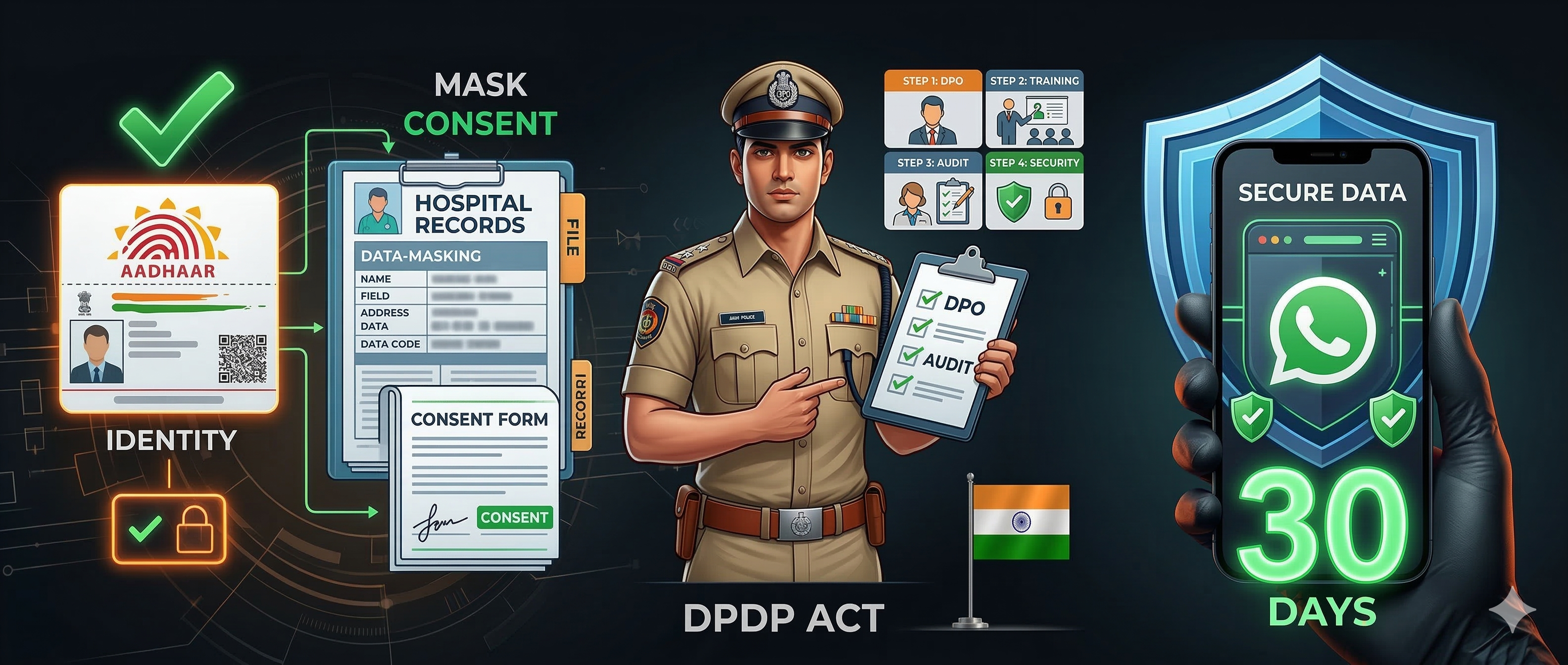
How Hospitals Can Become DPDP Compliant in 30 Days
India's hospitals are sitting on some of the most sensitive personal data in the country. Patient names, Aadhaar numbers, medical histories, diagnoses, treatment records, insurance details, and billing information. All of it collected daily, across hundreds of interactions.

Why Sending Aadhaar on WhatsApp is Illegal Under the DPDP Act
Open your WhatsApp right now. Scroll back six months. There is a ninety percent chance you will find an Aadhaar card. Maybe yours. Maybe a family member’s. Maybe someone you sent it to for a hotel check-in, a job application, a school admission, or a rental agreement.
Secure your data infrastructure.
Stay ahead of DPDP compliance with Sakshya's AI-first document gateway.